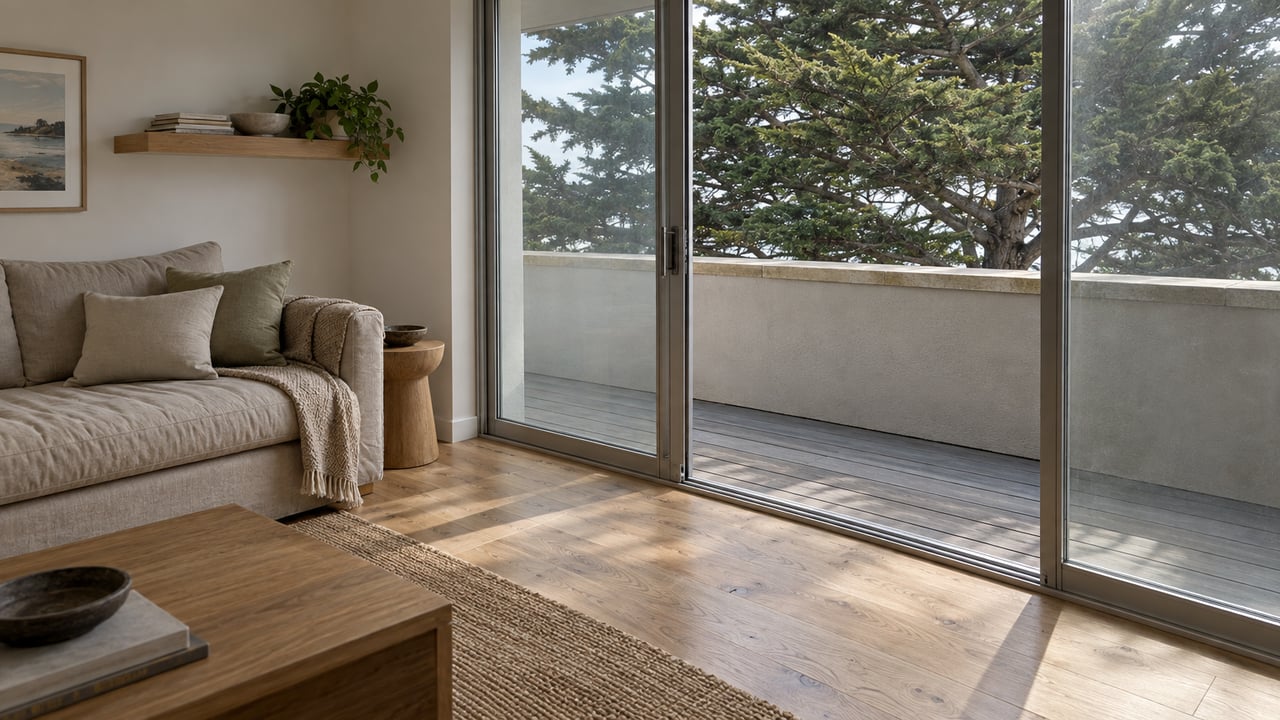
Two Monterey condos can list at the same price per square foot and still not be the same purchase. One clears underwriting without a hiccup. The other stalls at the lender's desk over a building-level document that has nothing to do with the unit's granite counters or its view. The gap between them is not price. It is a California balcony law that took effect last year and a Fannie Mae rule change that landed this spring, and together they have quietly split Monterey's condo stock into buildings that finance easily and buildings that do not.
If you are comparing units on the portals right now, the median price per square foot tells you almost nothing about which side of that line a given building sits on.
A deadline that already passed
California's Senate Bill 326 requires condominium associations with three or more units to inspect exterior elevated elements, meaning balconies, decks, walkways and stairways supported substantially by wood and more than six feet off the ground, and to have that inspection done by a licensed structural engineer or architect. The first inspection deadline was January 1, 2025. That date is not a future concern. It has passed, and any Monterey HOA that has not completed its inspection is currently out of compliance, not approaching a deadline.
This distinguishes SB 326 from the more familiar SB 721, which covers rental apartment buildings and only reached its own first deadline on January 1, 2026. Buyers sometimes assume the two laws share a timeline. They do not, and a condo board that conflates them can be a year or more behind without realizing it.
The findings matter as much as the inspection itself. Reports from HOA attorneys tracking compliance describe insurance premium increases of 100 to 400 percent at buildings that cannot document a completed inspection, and lenders in some cases classifying routine repair recommendations as critical, enough to pause financing on a pending sale. None of this touches the unit a buyer is trying to purchase. It touches the building the unit sits inside.
The report now travels with the sale
A second law closes the gap between what a board knows and what a buyer sees. Senate Bill 410, effective January 1, 2026, requires condominium associations to disclose their most recent exterior elevated element inspection report to prospective purchasers as part of the standard resale disclosure package under the Davis-Stirling Act. Before this year, a buyer had to think to ask for the SB 326 report. Now it is supposed to arrive with the rest of the paperwork.
The inspection findings are also required to be folded into the HOA's reserve study under Civil Code section 5551. A reserve study completed before the balcony inspection, or one that never incorporates the results, is treated as legally incomplete. That distinction sounds procedural until a lender's underwriter reads the study and declines to rely on it.
Then Fannie Mae raised the bar again
In March 2026, Fannie Mae issued Lender Letter LL-2026-03, raising the reserve funding floor for condo project financing from 10 percent to 15 percent of a building's annual assessment income. For an association collecting $500,000 a year in dues, that moved the minimum reserve requirement from $50,000 to $75,000. A building can avoid the flat 15 percent rule if its own reserve study supports a different funding level, but for loan applications dated on or after August 3, 2026, that exception only holds if the association is funding at the study's highest recommended level, not merely somewhere within range.
The practical effect is a widening gap between buildings that pass this test and buildings that do not. A condo project that fails to meet the reserve threshold and lacks a qualifying study can be marked non-warrantable, meaning conventional lenders will not finance a purchase in it at all. That is not a rate problem. It is a whether-this-deal-happens problem, and it affects every future seller in the building, not just the one whose escrow it derails.
What this looks like across Monterey's condo stock
Monterey has somewhere around two dozen condominium complexes spread across very different settings, and the settings matter more than the price tags suggest. The city's two genuinely oceanfront condo communities sit directly on Del Monte Beach, the Ocean Harbor House on Surf Way and the Del Monte Beach Townhouses off La Playa. These are the buildings with balconies facing open water and daily salt spray, which is precisely the exposure SB 326 was written to address and precisely the condition that industry reports describe accelerating deterioration in older coastal buildings.
Compare that to Monterey's hillside stock in Skyline Forest, where complexes like Tanglewood and Mountain Shadows Townhomes sit up in the pines rather than at the waterline, or Skyline Ridge Estates a short drive from downtown. Condos in Skyline Forest have listed from the low $400,000s, a fraction of what a beachfront unit commands. The same is true of some of Monterey's newer, smaller boutique buildings, including a four-unit Cannery Row property at 575 Foam Street designed by architect Eric Miller, where construction is recent enough that the wood-and-salt-air conditions driving SB 326 findings elsewhere are less likely to have set in.
None of this means every waterfront building has a problem or every hillside building is clear. It means the variable that actually predicts financing risk, wood-framed elevated elements exposed to the coast for decades, tracks with location and age far more closely than it tracks with list price. A buyer who assumes the cheaper hillside condo carries more risk because it costs less has the logic backwards. The building most likely to trigger an SB 326 finding, a stalled reserve study, or a lender pause is often the most expensive one on the market, not the least.
What to ask before you write an offer
A few questions, asked before an offer rather than after, separate a smooth closing from a financing surprise:
- Has the association completed its SB 326 inspection, and if so, when
- What did the report find, and is a copy of the stamped engineer or architect report available
- Has the reserve study been updated to incorporate those findings, per Civil Code section 5551(f)
- Does the current reserve funding meet Fannie Mae's 15 percent floor, or does the association's own study support a different number
- What is the building's special assessment history over the past five years
A listing agent is not always going to volunteer this. It is worth requesting directly, and worth reviewing before removing a loan contingency.
A few questions this raises
Does any of this apply to single-family homes or planned developments in Monterey? No. SB 326 applies to condominium common interest developments where the HOA owns or maintains the exterior. In a planned development where each owner is responsible for their own balcony under the CC&Rs, the law generally does not apply, though it is worth confirming the property's legal classification rather than assuming.
Does this matter if I am paying cash? Less directly. The financing questions above are lender-driven, so a cash buyer is not subject to the same underwriting checkpoints. The insurance and special assessment exposure remain relevant regardless of how the purchase is funded, since an underfunded reserve or a large balcony repair bill lands on every owner in the building.
Is this specific to Monterey, or true statewide? The laws are statewide. What is local is the mix of building ages and exposure that determines how often they actually come into play, and Monterey's split between decades-old oceanfront stock and newer hillside and boutique buildings makes that mix unusually visible.
None of this shows up in a median price chart. It shows up in a reserve study, an inspection report, and a conversation with someone who has read both.
If you are weighing a Monterey condo against the rest of the Peninsula's coastal inventory, Ryan Sherman can walk through a specific building's reserve health and compliance status before you write an offer. Schedule a private consultation.
