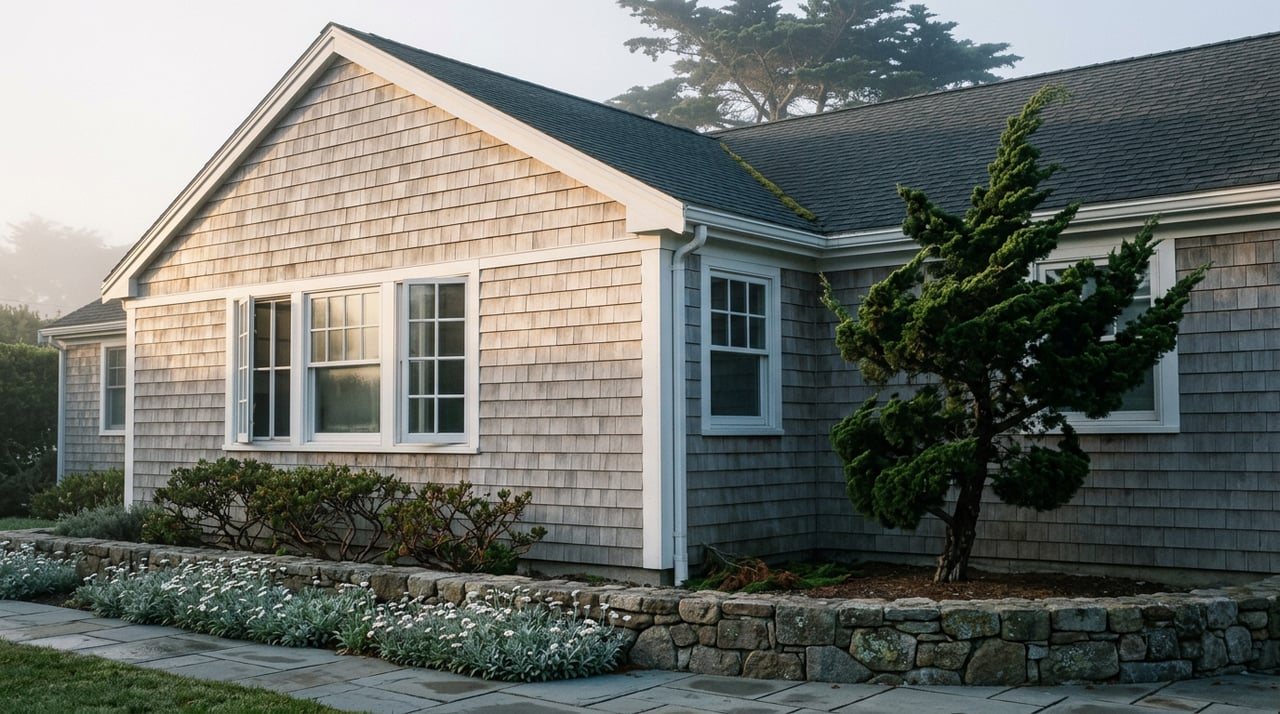
Say you're under contract on a shingled cottage a few blocks from downtown Pacific Grove. The current owner has been running it as a vacation rental for years, the listing mentions the income, and you've already mentally spent it. Then, somewhere between inspection and close, you learn the one detail that changes the math: the license stays with the seller. You're not buying an income property. You're buying a house that used to have one.
That's not a hypothetical quirk. It's written directly into how Pacific Grove runs its short-term rental program, and it's the piece of the picture that most conversations about Pacific Grove real estate skip past on the way to talking about price.
The cap sounds like the ceiling. It isn't.
Pacific Grove limits short-term rental licenses to 250 citywide, and today only 84 are active. On paper, that reads like plenty of room. If you're comparing it to Carmel-by-the-Sea, where whole-home rentals are banned outright in residential zones, Pacific Grove looks wide open by comparison.
But 166 unused slots against a 250 cap tells you almost nothing about whether your house, specifically, could ever hold one. The cap is a citywide number. Eligibility is a parcel-by-parcel question, and most of Pacific Grove was disqualified before the cap ever mattered.
Most of the town was never in the running
Short-term rental licenses in Pacific Grove are only issued in the Coastal and Commercial zoning districts. Everywhere else, meaning the bulk of the city's single-family residential streets, whole-home rentals aren't a numbers problem. They're a zoning problem that a lottery or a waitlist can't fix.
A zoning analysis by the resident group Pacific Grove Neighbors United estimated roughly 626 residential parcels sit inside the Coastal Zone compared to about 5,081 outside it. That's a rough order of magnitude, not a precise inventory, but it points at the same conclusion from a different angle: the pool of homes that could ever legally hold an STR license is a small slice of the city's housing stock, no matter what the citywide cap says. If you're touring homes in Country Club Gate or the Fourth Addition with rental income in mind, the conversation about "is there room under the cap" is the wrong conversation. The right one is "is this parcel even in a zone where the city will consider an application."
Fifty-five feet and fifteen percent
Even inside the eligible zones, the license isn't handed out freely. Two more rules narrow things further. First, a 55-foot "zone of exclusion" keeps new licenses from being issued within 55 linear feet of an existing STR parcel boundary. Second, when the city's current ordinance took shape, the council also capped STR concentration at no more than 15 percent of parcels on any given residential block.
Put those together and you get a market with clustering built into the rule. If a block already has its share of licensed rentals, a home two doors down from one might be permanently excluded, even while the citywide count sits nowhere near 250. The opening isn't spread evenly across town. It shows up in patches, and whether your specific address is inside or outside one of those patches is a question worth answering before you assume rental income is part of the deal.
Why the rule exists in the first place
None of this happened by accident. Pacific Grove voters passed Measure M in November 2018 with 58 percent support, after years of friction between residents who wanted quieter blocks and owners who'd built rental businesses around the previous, looser rules. The program still matters to the city's budget. Transient occupancy tax and associated fees from licensed rentals bring in an estimated $1.5 to $2.2 million a year, money the city has counted on for infrastructure and pension obligations.
"We have a plan if 'Yes' wins and if 'No' wins," Pacific Grove resident Joy Colangelo said on election night, capturing how contested the measure was even as it headed to a decisive win. The cap, the zone of exclusion, and the block density limit are all downstream of that vote. They're not administrative leftovers. They're the compromise the city landed on between rental income and residential character, and the city treats every license as a scarce civic asset rather than something that travels with the deed.
The line you cross at closing
That framing is exactly why the license doesn't convey with the sale. The City of Pacific Grove states it plainly on its own short-term rental program page: the permit does not transfer when a property changes hands. A new owner has to apply from scratch, current transient occupancy tax rate 12 percent, application fee $141 plus an additional $124 once the license is approved, and the application is screened against the same 55-foot exclusion zone and block density limits that apply to anyone else.
That means a currently licensed, currently profitable rental you're buying today could fail its own resurvey tomorrow, if another license got issued nearby in the interim or the block's density crept closer to its 15 percent limit. The seller's rental history is not a guarantee. It's a data point about what used to be true on that parcel, under a set of conditions that get re-checked the moment ownership changes.
If short-term income matters to your decision, the only reliable move is to confirm the parcel's current zoning eligibility and its zone-of-exclusion status before you're deep into escrow, not after. For anyone who wants rental income without touching that system at all, Pacific Grove does allow Home Sharing licenses citywide, with no cap, but only for renting a room while the owner or an authorized tenant lives on site. It's a real option. It's also a very different business than renting the whole house while you're away.
Pacific Grove versus Carmel-by-the-Sea
The two towns get compared constantly, usually on price and walkability. On rental rules, they're not even playing the same game.
| Pacific Grove | Carmel-by-the-Sea | |
|---|---|---|
| Whole-home STRs in residential zones | Allowed in Coastal/Commercial zones only, subject to cap | Prohibited |
| Citywide license cap | 250, with 84 currently active | Not applicable, residential STRs are banned |
| License transfers with sale | No, new owner must reapply | Not applicable |
| Owner-occupied room rentals | Home Sharing license, no cap, citywide | Governed separately, more restrictive |
Carmel's answer is unambiguous: residential means residential, and the rare exception lives in commercial zones as something closer to a small inn. Pacific Grove's answer looks more permissive on the surface, then resolves into a maze of zoning, spacing, and density rules that most buyers never see until they go looking for them.
What this means if rental income is part of your plan
The market itself is thinner than the price headlines suggest. Over the three months ending June 2026, Pacific Grove's median sale price sat near $1.5 million, with 46 homes sold in June, up from 35 the year before. That's real movement for a small coastal city, but it's still a market where a handful of transactions a month sets the tone, and where the rental-eligible slice of that inventory is smaller still.
None of this means Pacific Grove is a bad place to buy with income in mind. It means the due diligence looks different than it does in a market with no cap at all. Before you factor rental income into your offer, you want to know whether the parcel sits in an eligible zone, whether it clears the 55-foot exclusion test today, and whether the block is anywhere near its 15 percent limit. Those answers exist. They just don't show up on a listing sheet.
If you're weighing a Pacific Grove property against options elsewhere on the Peninsula and rental potential is part of the calculation, that's exactly the kind of groundwork worth doing before you write an offer, not after. Ryan Sherman works this market closely enough to walk through a specific parcel's zoning and licensing status before you're committed to anything. Schedule a private consultation to talk through what a given address can and can't support.
