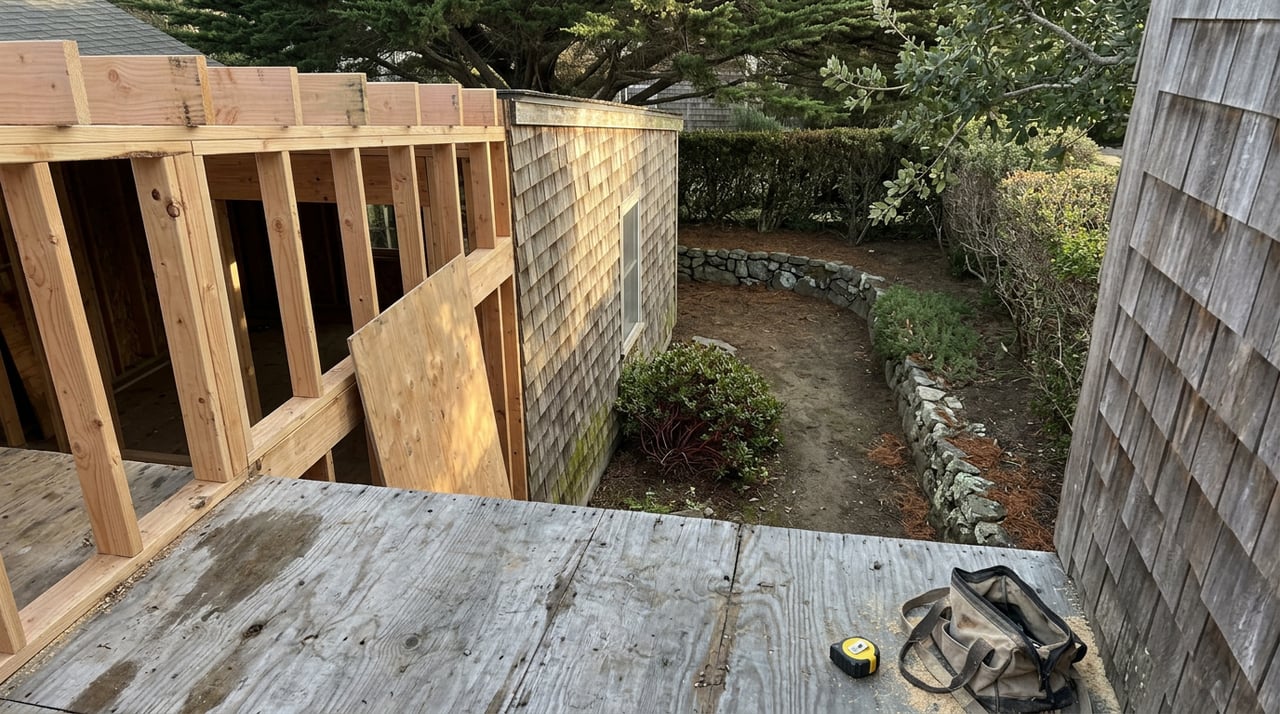
Two blocks from the ocean in Carmel-by-the-Sea, in a stretch of the village where finished homes trade between $5 million and $15 million, a couple recently closed on a lot and hired Dyar Architecture to design their house. Before a single wall went up, the design had to survive Carmel's residential review process, a process that, according to Forbes' January 2026 profile of the finished home, lets neighbors weigh in on what gets built next door. Roof height became the sticking point. Architect Erik Dyar solved it by partially embedding the lower level into the site, a workaround shaped as much by the review board as by the client's wish list.
That's not an unusual story here. It's the standard one.
If you're evaluating a Carmel cottage with renovation plans already forming in your head, the number that matters most isn't your contractor's bid. It's the calendar. Carmel-by-the-Sea runs one of the most layered residential review processes on the Monterey Peninsula, and the layers stack in ways that surprise buyers who assume a permit is a permit. Understanding how those layers actually work, before you write an offer, is what separates a renovation timeline you can plan around from one that ambushes you six months in.
Design review comes before the building permit, not alongside it
Most people budget for a building permit and move on. In Carmel, the building permit is often the easy part. The city requires a separate Design Study or Design Review approval from the Community Planning and Building Department for most exterior alterations and site coverage changes, and that approval has to happen before the building permit gets issued. The city runs two tracks: a staff-level review for smaller projects that don't need a coastal development permit, and a more involved track that goes to the Planning Commission for anything larger. The Planning Commission meets once a month, on the second Wednesday, which means a project that needs a hearing is working against a monthly clock before it even gets to construction scheduling.
The city describes its own goal plainly: preserve the character of a coastal village that it treats as an asset of statewide significance. That mission is exactly why the review exists, and exactly why it takes as long as it does.
The 50-year rule catches houses that don't look historic at all
Here's the detail that trips up more buyers than anything else. You don't need a landmark plaque on your cottage for historic review to apply. Under the city's rules, if your property is over 50 years old, a historic evaluation may be required before you get permits for exterior work, even if the house has never been placed on Carmel's Inventory of Historic Resources.
Carmel was founded in 1916 as an artists' colony, and the bulk of its housing stock was built across the following decades. Do the math from today's date and you'll find that a startling share of the village, including plenty of homes that read as simple mid-century remodels rather than storybook originals, clears that 50-year threshold without anyone intending it to. A buyer who plans to add a primary suite or swap out windows on a 1974 build can find themselves routed into the same evaluation process as the owner of a 1920s Comstock cottage, because the ordinance measures age, not architectural pedigree.
If the evaluation finds the home does qualify as a historic resource, exterior changes then need to satisfy the Secretary of the Interior's Standards for the Treatment of Historic Properties, reviewed either by staff for minor work or by the Historic Resources Board for anything major. Window replacements get particular scrutiny. The city's standard is unclad wood windows with true divided lights, and any change to window material, size, or placement needs Planning Department sign-off regardless of whether the house is formally designated.
Even the trees have a permit process
Removing or heavily pruning a tree on your own property in Carmel isn't a weekend job you schedule around a landscaper's availability. It runs through the City Forester's office, and the thresholds are specific enough to matter.
| Situation | Permit trigger |
|---|---|
| Oak, pine, cypress, or redwood, no active construction | 6 inches in diameter at breast height (DBH) |
| Same native species, with active construction on site | 2 inches DBH for any limb or root |
| Any other tree species, no active construction | 10 inches DBH |
| Removal permit fee | $698 |
| Evaluation or pruning permit, up to five trees | $205, credited toward the removal fee if the evaluation determines removal is warranted |
| Standard turnaround | About 6 weeks for non-emergency applications |
A dead or broken limb with no green in it can come down without a permit. Everything else, on a lot with mature Monterey pines or coast live oaks, which describes most of the village, goes through the same six-week queue that's already backed up behind design review.
Why the timelines compound instead of adding up
None of these review layers run on the same clock, and they don't always run in sequence either. Design Review and standard plan check alone can push a custom home or major remodel to a four-to-eight-month approval window before construction starts. Add Historic Resources Board review because the house cleared the 50-year mark, and that timeline extends further. Add a pool, and you're now also working through the Monterey Peninsula Water Management District's permitting process, which runs on its own separate schedule alongside the design review track.
Pools carry one more wrinkle worth knowing if you're picturing one for a future backyard. As of January 1, 2026, California's updated Title 24 energy standards require new pool construction to use a renewable primary heating source, a heat pump or solar thermal system, with gas serving only as backup. On a coastal site where a pool heater isn't optional given the marine climate, that's an added equipment decision layered onto an already multi-agency approval process. Existing pools and straight heater replacements are exempt, but new construction isn't.
Construction hours add a final, smaller constraint: work is limited to 8 a.m. to 6:30 p.m. Monday through Saturday, with nothing permitted on Sunday at all. It's a minor detail next to a four-to-eight-month approval runway, but it's one more way the village's small scale, a resident population of roughly 3,000 spread across a bit more than a square mile, shapes how projects actually get built.
What this means if you're evaluating a cottage right now
None of this should scare a buyer away from Carmel. It should change what they ask before writing an offer. If a property's appeal rests partly on what you plan to do to it, the questions worth asking a seller's agent or the planning department directly are specific: Is this property over 50 years old, and has it ever been evaluated for the Historic Inventory? Are there mature native trees near the footprint of planned work? Does the renovation vision include a pool, a rebuilt roofline, or new window openings, since each of those triggers a different review path?
The Forbes feature on the Dyar Architecture home is worth reading in full if you want to see what a successful project through this process actually looks like, roof height compromise and all. It's proof the system works for buyers who plan around it. It's also proof that "plan around it" means building the review calendar into your timeline the same way you'd build in inspection contingencies, not treating it as paperwork you'll deal with after closing.
Frequently asked questions
Does design review apply to interior remodels? Generally, no. The city's review process is aimed at exterior alterations and changes to site coverage. Interior work typically moves through standard building permits without the added design review layer, though structural changes can still require engineering sign-off.
Can I remove a dead tree without a permit? Yes. A dead or broken limb, meaning no green tissue remains, can be removed without going through the Forester's office. Anything alive above the DBH thresholds needs a permit first.
Is the 50-year historic trigger the same as being a designated landmark? No, and this is the part buyers miss most often. Being over 50 years old only means a historic evaluation may be required before exterior permits are issued. It doesn't mean the house is automatically restricted the way a listed historic resource would be, but it does add a review step that a newer home wouldn't face.
If you're weighing a Carmel-by-the-Sea property with a renovation already in mind, the numbers on the listing sheet only tell part of the story. The calendar tells the rest, and it's worth understanding before you're the one waiting on a Planning Commission agenda. Ryan Sherman works this market from both sides of a transaction and can walk you through what a specific property's review path is likely to look like before you write an offer. Schedule a private consultation to talk through it.
